
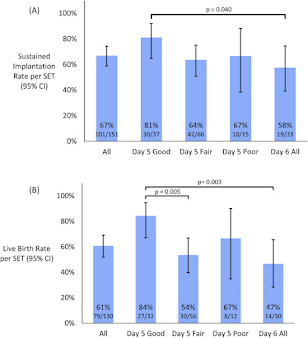
Comparison of sustained blastocyst implantation rate at all ages
Day 5 good blastocyst > Day 5 medium blastocyst > Day 5 poor blastocyst > Day 6 embryo
There is a slight negative correlation between day 5 blastocyst implantation rate and age >36 years.
There was a significant negative correlation between day 6 blastocyst implantation rate and age >36 years.
The best-quality whole haploid day 5 embryos had a high fertility rate of 80% at all ages.
The implantation rate of average/poor quality day 5 embryos and day 6 embryos is about 50%
https://www.sciencedirect.com/science/article/pii/S1472648321002923
There was a clinically significant higher sustained implantation rate at all ages for euploid day 5 good quality embryos compared with day 5 fair, day 5 poor and day 6 embryos.
- For all ages the sustained implantation rates for day 5 good quality blastocysts were higher than for day 5 fair, day 5 poor and day 6 blastocysts. The number of blastocysts was higher than for day 5 fair, day 5 poor and day 6 blastocysts.
- At a maternal age of 36 years the best-fit sustained implantation rates were 86% for day 5 good quality blastocysts, 64% for day 5 fair, 63% for day 5 poor, and 51% for all day 6 blastocysts analysed as one group. fair, 63% for day 5 poor, and 51% for all day 6 blastocysts analysed as one group.
- The best-fit sustained implantation rates for age 33 compared to age 39 years were 86% versus 80% for day 5 good, 71% versus 62% for day 5 fair, 59% versus 55% for day 5 poor, and 81% versus 46% for all day 6.
- The best quality euploid day 5 embryos had a SIR of 80-90% at all ages.
- Even fair/poor quality day 5 embryos and day 6 embryos had a SIR of approximately 50% or greater.
- euploid blastocyst transfers a reasonable performance goal is an overall SIR of 60-65% per embryo and a LBR of 50 -60% per embryo.

