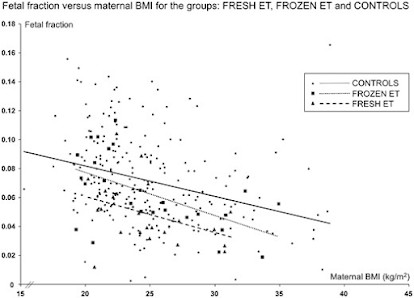
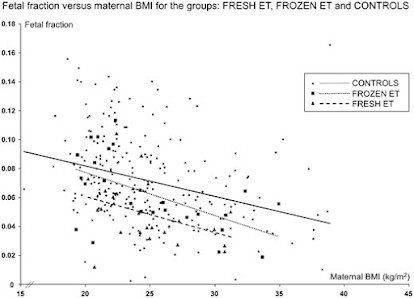
The Fetal fraction (FF) of pregnancies after fresh ET was even lower compared to frozen embryo implantation ET, which may reflect the tendency for smaller gestational ages after fresh ET compared to natural cycle frozen ET.
Comparison of FF values: natural pregnancy>FET>fresh ET
As the mother's BMI increased, FF decreased significantly
significant reduction in the FF in ART patients compared with naturally conceived pregnancies, which seems to be more pronounced after fresh ET compared This seems to be more pronounced after fresh ET compared with frozen ET.
a significant reduction in FF with increasing maternal BMI
Fetal fraction (FF) of cell-free DNA in pregnancies after fresh or frozen embryo transfer following assisted reproductive technologies
Human Reproduction, Volume 35, Issue 6, June 2020, Pages 1267-1275, https://doi.org/10.1093/humrep/deaa110
I
SUMMARY ANSWER
This study shows a significant reduction in the FF in ART patients compared with naturally conceived pregnancies, which seems to be more pronounced after fresh ET compared with frozen ET.
main results and the rise of chance
We found a reduction in FF in ART patients compared with naturally conceived pregnancies, and the reduction was more pronounced for ART pregnancies after fresh ET (mean FF = 0.049) compared with frozen ET (mean FF = 0.063) (multivariate analysis adjusted for maternal BMI, P = 0.02). Another multivariate analysis, adjusted for BMI and multiples of median (MoM) values for pregnancy-associated plasma protein-A (PAPP-A), demonstrated a significantly reduced FF for pregnancy. demonstrated a significantly reduced FF for ART pregnancies (mean FF = 0.056) compared with naturally conceived pregnancies (mean FF = 0.072) (P < 0.0001 ). We found that FF was significantly reduced with increasing maternal BMI (P < 0.0001) and with decreasing MoM values of PAPP-A (P = 0.003).
WIDER IMPLICATIONS OF THE FINDINGS
Concurrent with other studies demonstrating a reduced FF for singleton pregnancies after ART treatment compared with naturally conceived pregnancies, we found a reduction in FF between the two groups. We find that FF is even more reduced in pregnancies following fresh ET compared with frozen ET, hence the existing knowledge is limited. We find that FF is even more reduced in pregnancies following fresh ET compared with frozen ET, which might possibly reflect the predisposition of being small for gestational age after fresh ET compared with natural cycle frozen ET.