
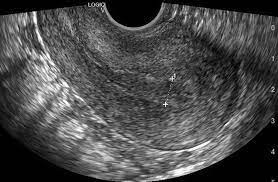
Endometrial compaction (EC) is defined as the difference in endometrial thickness from the end of the follicular phase to the date of embryo transfer (ET).
The predictive value of EC in determining IVF conception rates is still controversial.
=====================================================================
This study shows that women with dense EC endometrium on the day of ET had significantly higher clinical pregnancy rates compared to women with no change or thickening.
Clinical pregnancy rates were significantly higher in women with endometrial compaction on ET day compared to women with no changes or thickening.
https://link.springer.com/article/10.1007/s10815-023-02809-
=====================================================================
This study shows that EC has little predictive value in determining IVF abortion rates.
J Assist Reprod Genet
. 2023 Nov;40(11):2513-2522. doi: 10.1007/s10815-023-02942-5. Epub 2023 Sep 20.
Can endometrial compaction predict live birth rates in assisted reproductive technology cycles? A systematic review and meta-analysis
Purpose: Endometrial compaction (EC) is defined as the difference in endometrial thickness from the end of the follicular phase to the day of embryo transfer (ET). We aimed to determine the role of EC in predicting assisted reproductive technology (ART) success by conducting a meta-analysis of studies reporting the association between EC and clinical outcomes of ART. association between EC and clinical outcomes of ART.Methods: MEDLINE via PubMed, Web of Science, Scopus, and the Cochrane Central Register of Controlled Trials (CENTRAL). Methods: MEDLINE via PubMed, Web of Science, Scopus, and the Cochrane Central Register of Controlled Trials (CENTRAL) were searched from the date of inception to May 19, 2023. The primary outcome was live birth rate (LBR) per ET. The primary outcome was live birth rate (LBR) per ET. Secondary outcomes were live birth or ongoing pregnancy per ET, ongoing pregnancy per ET, clinical pregnancy per ET, and miscarriage per clinical pregnancy. Results: Fifteen studies were included. When data from all studies reporting live birth were pooled, overall LBR rates were comparable in cycles showing When data from all studies reporting live birth were pooled, overall LBR rates were comparable in cycles showing EC or not [RR = 0.97, 95%CI = 0.92 to 1.02; 10 studies, 11,710 transfer cycles]. In a subgroup of studies that included euploid ET cycles, a similar LBR for patients with and without EC was noted [RR = 0.99, 95%CI = 0.86 to 1.13, 4 studies, 1172 cycles]. studies, 1172 cycles]. The miscarriage rate did not seem to be affected by the presence or absence of EC [RR = 1.06, 95%CI = 0.90 to 1.24; 12 studies]. Conclusion: The predictive value of EC in determining LBR is limited, and assessment of EC may no longer be necessary, given these findings.
=====================================================================
