
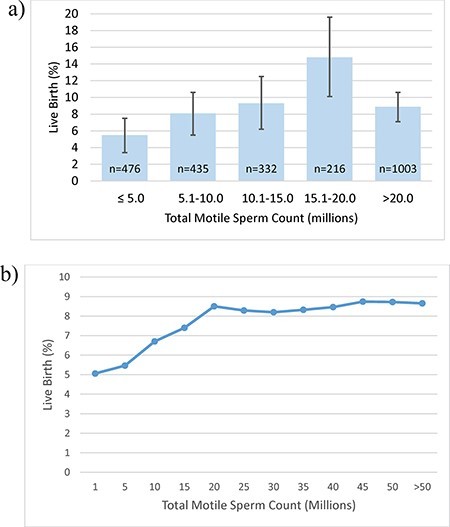
The most important male factor affecting the success rate of artificial insemination is the total motile sperm count (TMC).
Lower insemination TMC is associated with lower live birth rates.
Higher TMC is associated with higher live birth rates (TMC 15-20 million (14.81 TP3T) compared to ≤5 million (5.51 TP3T))
The time from hCG injection to IUI, sperm preparation method and ultrasound guidance for IUI were not associated with success rates.
Intrauterine insemination performance characteristics and post-processing total motile sperm count in relation to live birth for couples with unexplained infertility in a randomized, multicentre clinical trial
Human Reproduction, Volume 35, Issue 6, June 2020, Pages 1296-1305,
lower inseminate TMC were associated with a reduced live birth rate.
While time from hCG injection to IUI, sperm preparation method and ultrasound guidance for IUI were not associated with live birth success.
Time from hCG trigger injection to IUI was not significantly associated with outcome.
Higher TMC was associated with greater live birth rate (TMC 15.1-20.0 million (14.8%) compared to ≤5 million (5.5%)) (aRR 2.09 ( 1.31-3.33)). However, live births did occur with TMC ≤ 1 million (5.1%).
Higher TMC inseminated leads to an increase in live birth rate up to TMC ~20 million
