
Self-correcting mechanisms may exist in chimeric embryos mosaic, and chimeric embryos may develop into normal embryos.
Most meiosis-derived aneuploids occur during oogenesis.
More than 501 TP3T in oocytes produced by women over 40 years of age have been shown to be chromosomally abnormal.
The incidence of chromosomal abnormalities in the sperm of fertile men ranges from 3% to 5%.
The chance of accurately diagnosing an embryo abnormality was 1001 TP3T, while the proportion of whole-haploid embryos classified as clinically appropriate was 61.91 TP3T.
J Assist Reprod Genet 2024 May;41(5):1127-1141.
Hum Reprod. 2019 Apr 1;34(4):758-769.
There may be a self-correcting mechanism in mosaic embryos, which allows some mosaicisms to potentially develop into normal embryos.
Majority of meiotically derived aneuploidies arise during oogenesis.
More than 50 % of oocytes generated by women over the age of 40 years were demonstrated to be chromosomally abnormal.
The incidence of chromosome anomalies ranged between 3 and 5 % in the sperm of fertile men.
The probability of accurately diagnosing an embryo as abnormal was 100%, while the proportion of euploid embryos classified as clinically suitable was 61.9%.
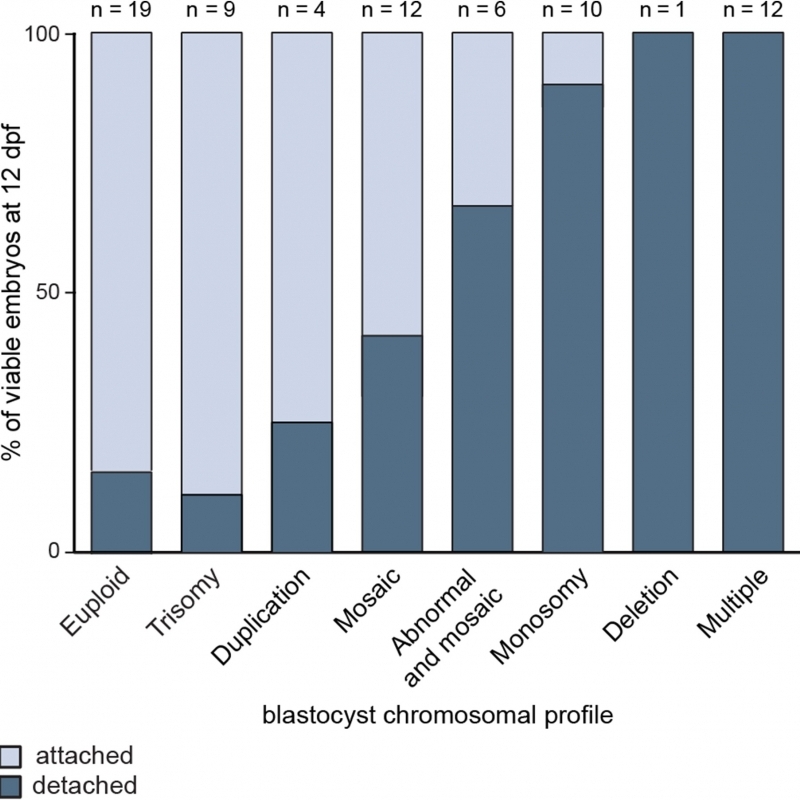
Figure 2Blastocyst chromosomal profiles related to culture outcomes. Euploid blastocysts and those presenting with chromosomal gains and mosaicism were significantly more likely to remain viable 12 days post-fertilisation (dpf) compared to blastocysts with chromosomal losses or multiple mosaicism. were significantly more likely to remain viable 12 days post-fertilisation (dpf), compared to blastocysts with chromosomal losses or multiple aberrations. aberrations.
